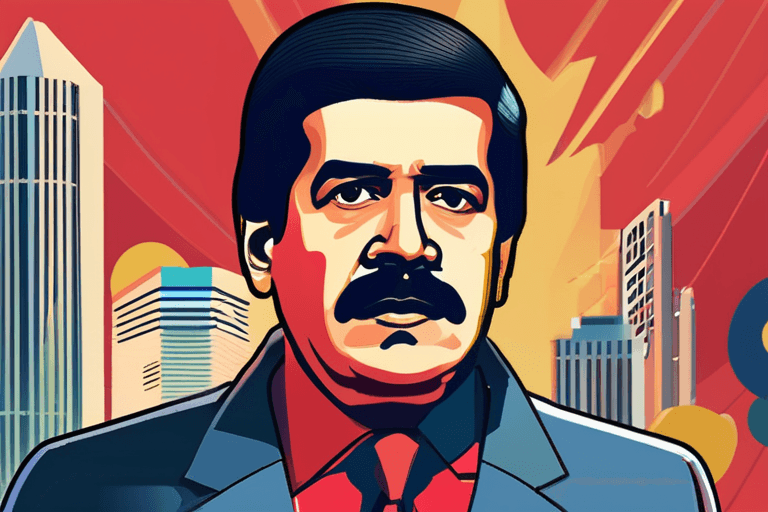
The courtroom in New York was a stark contrast to the opulent Miraflores Palace, the usual backdrop for Nicolás Maduro. Gone were the cheering crowds and the carefully curated image of unwavering power. Instead, a single, defiant figure stood before the judge, pleading not guilty. But as Maduro navigated the complexities of the American legal system, a different kind of power struggle was unfolding back in Venezuela. The nation, long accustomed to Maduro's rule, was quietly, yet strategically, regrouping.
The arrest of Maduro, a seismic event broadcast live across the globe, sent shockwaves through Venezuela's political and economic landscape. For years, the country has grappled with hyperinflation, shortages of basic goods, and widespread emigration. Maduro's government, often accused of authoritarianism and corruption, had become synonymous with the nation's struggles. Now, with Maduro facing trial in the US, a power vacuum has emerged, creating both uncertainty and opportunity.
According to Bloomberg's Jill Disis, reporting live from Caracas, the government is actively working to project an image of stability and continuity. "While Maduro's legal battles play out in New York, key figures within the government are emphasizing the need for unity and continued progress," Disis reported. "They are keen to demonstrate that Venezuela can function effectively even in Maduro's absence."
This regrouping isn't simply a matter of political maneuvering. It's also a technological one. The Venezuelan government, under the guidance of a newly appointed interim council, is reportedly accelerating its adoption of blockchain technology to circumvent international sanctions and facilitate trade. This includes exploring the use of the Petro, the country's controversial cryptocurrency, and developing new decentralized finance (DeFi) platforms.
"Venezuela has been forced to innovate out of necessity," explains Dr. Adriana Gonzalez, a professor of economics at the Central University of Venezuela. "Sanctions have crippled the traditional financial system, pushing the government to explore alternative solutions. Blockchain, while still nascent, offers a potential pathway to bypass these restrictions."
The government's push for technological autonomy extends beyond finance. There are reports of increased investment in domestic AI development, aimed at improving efficiency in key sectors such as agriculture and energy. This initiative, while ambitious, faces significant challenges, including a shortage of skilled engineers and limited access to advanced computing infrastructure.
"The AI buildout is facing bottlenecks," Bloomberg Technology reported earlier this week. "Access to high-performance GPUs and a reliable power supply remain major obstacles. Venezuela needs to address these infrastructural challenges to realize its AI ambitions."
However, the situation is not without its critics. Opposition leaders argue that the government's technological initiatives are merely a smokescreen to consolidate power and maintain control over the country's resources. They point to the lack of transparency surrounding the Petro and the potential for AI to be used for surveillance and repression.
Despite the skepticism, the technological shift in Venezuela is undeniable. Whether it will lead to genuine economic progress and greater political freedom remains to be seen. As investors hunt for something new in AI, as Anna Rathbun noted, Venezuela's experiment with technology under pressure is one to watch closely. The future of Venezuela, it seems, is being forged not only in the courtroom, but also in the digital realm.














Discussion
Join the conversation
Be the first to comment